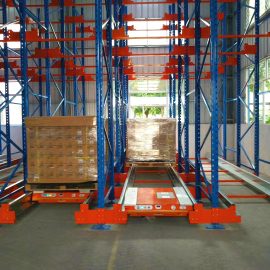
Fabricant de système de rayonnage à navette pour entrepôt robuste


Catégories Rayonnage navette, Voir tous les rayonnages à palettes
Un support navette, également connu sous le nom de système de navette de palettes, est une solution avancée de stockage en entrepôt. Il se compose d'une structure de rayonnage et d'une navette à palettes alimentée par batterie. (une calèche) qui se déplace de manière autonome le long des voies à l'intérieur des couloirs de stockage. Cliquez sur le bouton comme ci-dessous pour un coût instantané.
| L*D*H (mm) | 2400*800*3000, 2700*900*4000 personnalisable |
|---|---|
| Couleur | Bleu, Orange,Gris,Blanc Personnalisable |
| Couche | 2Couche,3Couche, 4Couche, 5Couche, Personnalisable |
| Capacité de charge | 1000kilos, 2000kilos, 3000kilos, Personnalisable |
| MOQ | 10 ensembles |
| Poids | à propos 120-180 kilos |
| Volume | 0.33CBM |
| Délai de livraison estimé | 15-25 jours |
Informations Complémentaires
Qu'est-ce que le système de rayonnage à navette?
Le support de navette le système fonctionne sous un “Premier arrivé, Premier sorti” (FIFO) ou “Dernier arrivé, Premier sorti” (LIFO) modèle de gestion des stocks, ce qui le rend idéal pour stocker des quantités massives de produits similaires avec un taux de rotation élevé. La navette est télécommandée par un opérateur, qui utilise une télécommande portable ou un système de gestion d'entrepôt (WMS) charger, récupérer, ou repositionner les palettes dans le rack.
Dessins de conception gratuits pour vous
Plan d'aménagement
Fournissez-nous les dimensions de votre entrepôt, et nos ingénieurs experts créeront un plan précis pour vous.
Demander une conception de dessin
Vue en trois dimensions
Vous pourrez vérifier à travers l’épaisseur des matériaux, dimensions des casiers, nombre de niveaux, et spécifications supplémentaires.
Demander une conception de dessin
Rendus
Nos ingénieurs sont également capables de créer des rendus visuels et des guides d'installation détaillés pour simplifier le processus de configuration de votre système de rayonnage..
Demander une conception de dessin
Installation d'un rack navette
D'abord, assembler le cadre de rayonnage, s'assurer que les montants et les poutres sont solidement fixés. Suivant, installer les rails de guidage dans les racks pour que la navette puisse avancer. Alors, placer la navette sur les rails, s'assurer qu'il est correctement aligné et opérationnel. Enfin, tester le système avec quelques palettes pour confirmer le bon fonctionnement et ajuster si nécessaire pour des performances optimales.
Le processus de production principal des supports de navette

1
Processus de poinçonnage
Les trous sont espacés sur toute la longueur de la plaque de suspension à intervalles réguliers, généralement espacés de 50 mm ou 75 mm, pour fixer les traverses.
2
Processus de roulement
Les montants et les poutres sont façonnés à partir de bobines d'acier à l'aide de machines à rouler, avec des poutres souvent classées comme poutres P et poutres de verrouillage, tandis que les montants comportent généralement des trous en diamant ou en forme de larme.
3
Processus de soudage
En soudant la plaque d'accrochage à la poutre et le montant à la platine, une connexion sécurisée est obtenue, améliorant considérablement la stabilité structurelle du système de rayonnage.
4
Processus de pulvérisation et de cuisson
Après soudage, le produit est poli, suivi de l'application d'une technologie de revêtement en poudre électrostatique sur sa surface, qui est ensuite durci dans un four à haute température pour garantir une finition lisse.
5
Processus d'emballage
Atteindre la phase finale, une fois la fabrication du produit terminée, nous procédons généralement au conditionnement des articles destinés à l'exportation. Cette étape garantit une protection contre les dommages pendant le transport longue distance et une protection contre la corrosion due à l'exposition à l'eau de mer tout au long du processus d'expédition..
Nos produits sont emballés des manières suivantes

Film à bulles d'air

Caisse en bois

Emballage de palettes

Boîte en carton
Ce que vous voulez savoir sur le système de rayonnage Shuttle
Un système de racks à navette améliore considérablement l'efficacité du stockage en entrepôt grâce à plusieurs mécanismes clés:
Stockage haute densité: En utilisant plus efficacement la profondeur des couloirs de stockage, les racks navettes minimisent le besoin d’allées multiples, permettant une plus grande densité de stockage de palettes dans le même encombrement. Cela maximise l’utilisation de l’espace et peut augmenter considérablement la capacité de stockage globale de l’entrepôt..
Temps de chargement et de déchargement plus rapides: La navette à palettes automatise le mouvement des palettes dans et hors des voies de stockage, réduisant le temps nécessaire au chargement et au déchargement par rapport aux opérations traditionnelles avec chariot élévateur. Cette automatisation accélère les opérations de l'entrepôt et augmente le débit.
Coûts de main-d'œuvre réduits: L'automatisation avec des racks à navette minimise le besoin d'opérations manuelles avec un chariot élévateur, conduisant à une réduction des coûts de main d’œuvre. Il permet au personnel de l'entrepôt de se concentrer sur d'autres tâches productives, améliorant ainsi l'efficacité opérationnelle.
Sécurité améliorée: Étant donné que le système de navette minimise le besoin de chariots élévateurs pour entrer dans les voies de stockage, le risque d'accidents et de dommages à la structure du rack est considérablement réduit. Cela garantit non seulement la sécurité du personnel de l'entrepôt, mais contribue également à maintenir l'intégrité des marchandises stockées..
Oui, les systèmes de racks à navette sont bien adaptés aux environnements d'entreposage frigorifique. Ils sont conçus pour fonctionner efficacement dans des conditions de basse température, souvent jusqu'à -30°C (-22°F). La batterie et les composants de la navette sont spécialement conçus pour résister aux températures froides, garantir des performances fiables et minimiser le besoin de travail manuel dans des conditions difficiles. Cette capacité rend les systèmes de racks navette idéaux pour les aliments surgelés, médicaments, et tout autre produit nécessitant un stockage réfrigéré, améliorant à la fois l’efficacité opérationnelle et l’intégrité des produits dans les entrepôts frigorifiques.
Les systèmes de racks navette sont idéaux pour stocker une large gamme de produits,tel que Marchandises périssables, Articles en vrac, Produits uniformes, Produits saisonniers, Produits d'entreposage frigorifique, Articles de grande valeur et mon fils.
Les systèmes de racks navette sont conçus avec flexibilité pour s'adapter à différentes tailles de palettes, garantir qu'une large gamme de produits peut être stockée efficacement. Voici comment ils s’adaptent aux différentes dimensions de palettes:
Largeurs de rail réglables: Les rails à l'intérieur des voies de rayonnage de la navette sur lesquelles la navette fonctionne peuvent être ajustés pour s'adapter à différentes largeurs de palettes.. Cet ajustement permet au système de manipuler des palettes de différentes tailles en toute sécurité.
Unités de navette programmables: Les unités de navette elles-mêmes peuvent être programmées pour reconnaître et fonctionner avec différentes tailles de palettes. Cela garantit que la navette se positionne correctement pour ramasser ou déposer des palettes sans causer de dommages ou de désalignement..
Conception modulaire: Les systèmes de racks à navette présentent souvent une conception modulaire, permettant la configuration des racks en fonction de la profondeur des différentes palettes. Cette flexibilité de conception garantit que chaque palette est stockée efficacement, maximiser l'utilisation de l'espace.
Voies personnalisables: La profondeur des couloirs de stockage peut être personnalisée en fonction de la taille des palettes stockées. Cette personnalisation garantit que les palettes courtes et longues peuvent être logées dans le même système., si nécessaire.
Niveaux de hauteur variables: L'espace vertical entre les niveaux dans un système de rayonnage à navette peut être ajusté pour s'adapter à la hauteur des différentes palettes, garantir que les articles plus grands disposent d'un espace suffisant tout en maximisant la densité de stockage.
Plusieurs options de navette: Certains systèmes proposent différents modèles de navettes conçus pour fonctionner avec des tailles de palettes ou des capacités de poids spécifiques., permettant aux entrepôts de choisir la navette qui correspond le mieux à leur profil d'inventaire.
La capacité de charge maximale d'une navette dans un système de rack à navettes varie généralement de 1000 kg à 1500 kg pour les modèles standards.
Les opérateurs contrôlent la navette dans un système de racks à navettes à l'aide d'une télécommande ou d'un système de gestion d'entrepôt. (WMS) interface. Ces méthodes de contrôle permettent de contrôler avec précision les mouvements de la navette, y compris le chargement, déchargement, et repositionnement des palettes dans le système de rayonnages.
Le coût est d'environ USD 70- USD 80 par position de palette.
De nombreux facteurs affectent les temps de facturation, comme le chargement, l'intensité des opérations d'entrepôt et les conditions environnementales. Tu pourrais raconter ton idée, alors je vous recommanderai la meilleure solution.
Obtenez des devis instantanés de nos ingénieurs en coûts
Vous pourriez également être intéressé par ces produits